Ribeye and Bacon Every Day: Do the Calories Count?
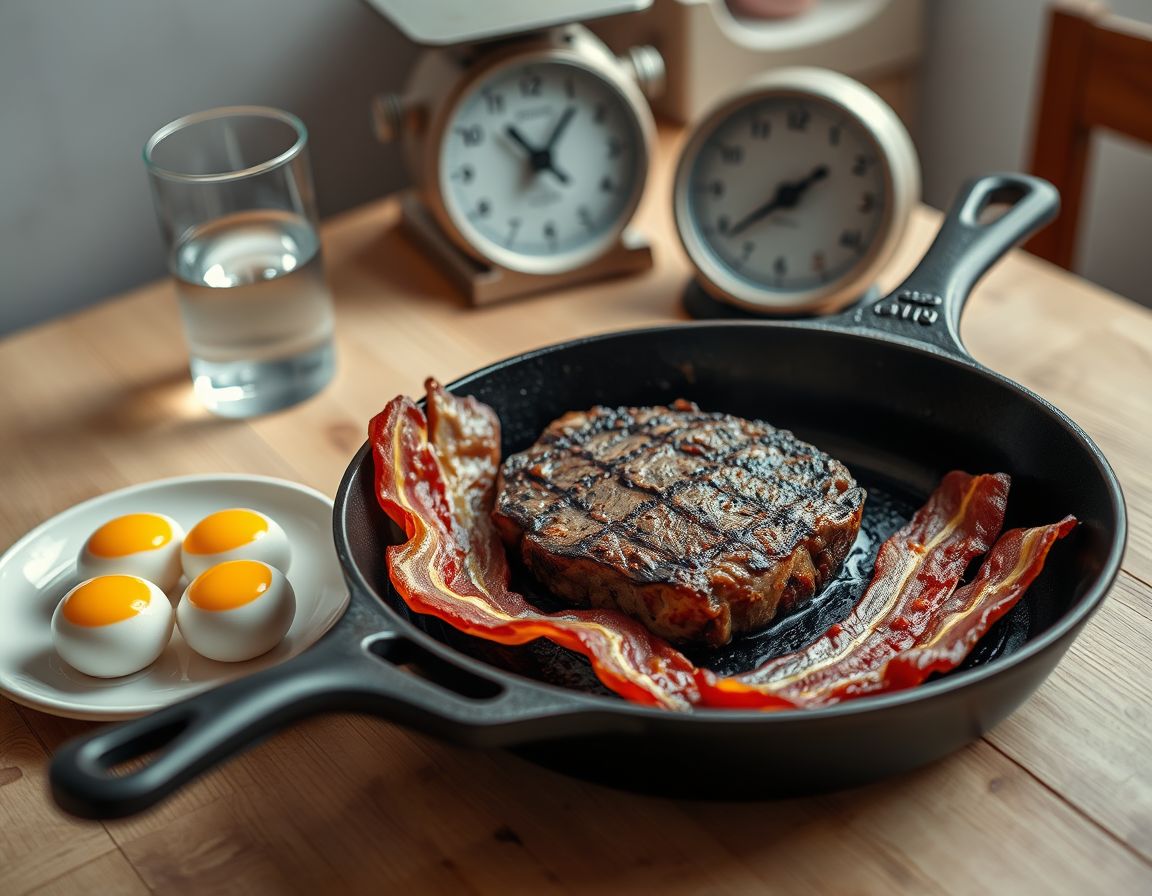
Somebody asks this every week. Ribeye for dinner, bacon with breakfast, butter on everything, and the scale won't move. So do the calories count or not?
Yes. They always counted. But that doesn't mean you should be counting them, and it definitely doesn't mean fat is the enemy. Here's the math.
Run the numbers on an actual ribeye day
Let's build the day people are actually worried about.
- Breakfast: 3 eggs and 4 slices of bacon. About 30 g protein, 28 g fat, just under 400 calories.
- Dinner: a 12 oz ribeye. Roughly 70 g protein, 70 g fat, about 900 calories.
That's 100 g protein, 98 g fat, around 1,280 calories. Notice the ratio. The ribeye itself sits at roughly 1 gram of fat per gram of protein, which is right at the satiety baseline most people land on naturally. The steak isn't the problem.
Now add the stuff nobody logs. Two tablespoons of butter melted on the steak. A tablespoon of tallow in the pan. Four tablespoons of heavy cream across two coffees. An ounce of cheese in the afternoon.
That's roughly 635 more calories and 68 more grams of fat. The day is now about 1,917 calories, with 166 g of fat against 100 g of protein. You went from 1:1 to about 1.7:1 without adding a single bite of meat.
That's the whole article in one paragraph. Nobody stalls on ribeye. People stall on what they pour on top of it.
Protein is the anchor. Fat is the lever.
Set protein first, off your goal body weight, not your current weight. Most people land at 0.8 to 1.0 g per pound of goal weight. If you're training hard, up to 1.2.
Say your goal weight is 150 lb. That's 120 to 150 g of protein. Call it 135.
Then fat. Start around 1:1 by grams, so 135 g, and adjust from there. With 25 g of net carbs, that day runs 540 calories from protein, 1,215 from fat, 100 from carbs. About 1,855 total.
Fat is the number you move. Protein is the number you protect. That's the rule, and the recalculate your keto macros every 10 pounds habit keeps both honest as your body changes.
One more thing on protein: split it. Aim for 30 to 40 g per meal instead of one enormous dose at dinner. That matters more after 50, not less. In the day above, 100 g of protein arrived in two servings, one of them 70 g. Three meals of 40 to 45 g would serve you better.
Don't count. Until you audit.
These sound like opposite instructions. They're not. They're the same position at two different stages.
For the first eight weeks, don't count calories. Eat to satiety. A lot of people say the same thing: once you're fat adapted, you plate too much food and can't finish it. Without the carb crash, the ravenous two-hours-later feeling stops showing up. That signal is real, and counting calories on top of it just adds stress to something that's working. Our carnivore side worked through the same question and landed in the same place: whether you have to count calories on carnivore.
The audit comes later, and only if you're genuinely stalled. Here's the order.
- Confirm it's a real stall. Three to four weeks with no scale movement and no tape measure movement. Waist, hips, thigh. If the tape is moving, you're not stalled.
- Check sleep, stress, electrolytes. Boring, and it's the answer more often than macros are.
- Run a 7-day food audit. Weigh everything for one week. Especially added fat and dairy. Not forever, just seven days.
- Recalculate your targets at your current weight.
- Then consider a two-week dairy elimination or a deliberate maintenance break.
Skipping to step five is the most common mistake I see. People cut dairy in week two of a stall that isn't a stall yet.
And when you do audit, weigh your food. App estimates for fat are consistently soft, which is exactly why your AI food tracker is lying about your fat grams. A photo can't see the tablespoon of butter that melted into the pan.
How to trim fat without losing protein or ketosis
The order matters. Cut added fat first. Butter, tallow, oils, cream, extra cheese. Leave the fat that comes attached to your food alone.
Pulling 30 g of added fat drops you 270 calories a day. On that 1,855 calorie day, you'd land around 1,585. Over a week that's roughly 1,890 calories, and your protein didn't move a gram.
You will not fall out of ketosis doing this. Ketosis is driven by carbohydrate restriction, not by fat intake. Dropping butter while holding at 20 to 30 g net carbs keeps you exactly where you were.
Practical moves that cost you nothing:
- Cook in the fat that renders out of the meat instead of adding oil to the pan.
- Coffee: cream to splash, or black. Two coffees at 2 tbsp of cream each is 200 calories you never chewed.
- Move one meal to a leaner protein. Sirloin, chicken thigh, white fish. Same protein, half the fat.
- Add volume with low-carb vegetables. A big salad or a plate of roasted broccoli next to the steak is normal keto, not cheating. A lot of people eat a fairly ordinary looking plate, just without the starch.
That last one solves a psychological problem as much as a caloric one. The smaller-looking plate messes with your head early on. Volume fixes it.
If you want a sharper, time-boxed version of the same lever, PSMF days are protein held high and fat pulled way down for a short stretch. Useful tool. Not an everyday setting.
What a fair pace actually looks like
Week one, expect 3 to 7 lbs of water and glycogen. Less if you're smaller or older. That's not fat, and it doesn't repeat.
After that, 0.5 to 1.5 lb a week is the honest range. Over 50, plan on 0.5 to 1 lb and call that a win. Most people feel adapted around weeks four to six, and full fat adaptation takes eight to twelve. Judge the whole experiment at 60 to 90 days, not at day 19.
If hunger is the thing driving you crazy rather than the scale, that's a separate problem with a separate fix. Being ravenous at week 3 usually isn't your electrolytes.
Run your numbers through the KetoDial calculator for a starting point, set your protein target off your goal weight, and treat the fat number as a dial you're allowed to turn. That's the protocol.
I'm not a doctor. I've coached people and run these numbers on myself, so I know what tends to work in practice. I'm still not your doctor. If you take medication or you're managing a diagnosed condition, loop in the person who prescribes it before you change how you eat. Medication decisions belong to your prescriber. Your job is to show up with good data on what you're eating and what's changed.